
How Do You Play Wordle?
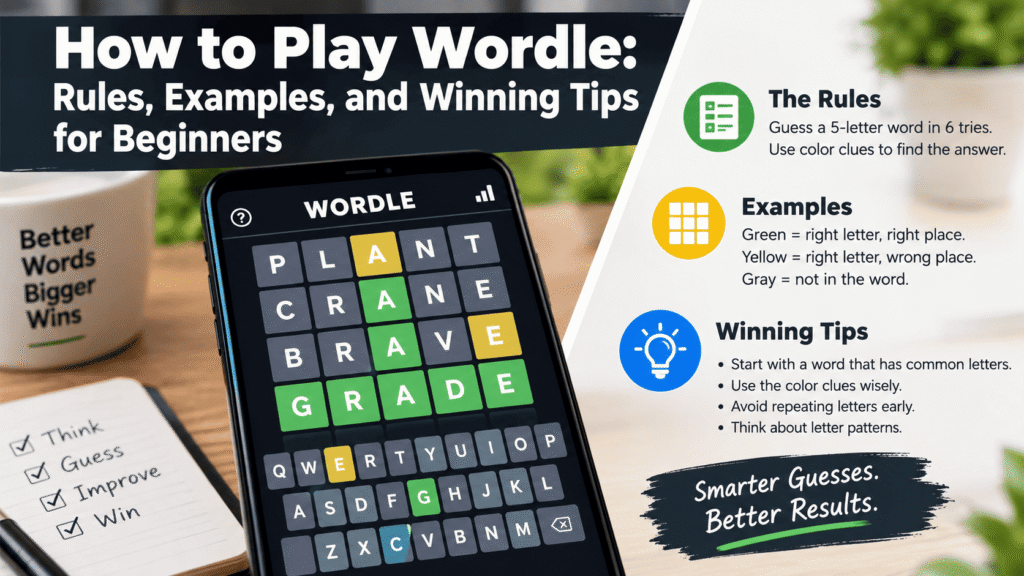
To play Wordle, guess a hidden five-letter word in six attempts. Enter a valid word and submit your guess to see colored tiles. Green means the letter is in the correct position, yellow means the letter appears elsewhere in the answer, and gray means the letter is not represented in the answer, taking repeated letters into account. Use these clues to improve your next guess until you solve the puzzle or run out of attempts.
What Is Wordle?
Wordle is a daily word-guessing game that tests vocabulary, logic, and problem-solving skills. Players attempt to identify a hidden five-letter word using feedback from each guess. The game does not provide traditional hints. Instead, its colored tiles show whether guessed letters match the answer.
The simple rules make Wordle suitable for beginners, while the six-attempt limit creates a challenge for experienced players. You do not need an extensive vocabulary to start. Learning how the colors work and choosing guesses carefully can help you make better decisions.
You can play the original daily puzzle on the official New York Times Wordle website. For additional guides and puzzle resources, visit the How to Play Wordle .
How to Play Wordle Step by Step
Step 1: Open the Wordle Game
Open the official Wordle game in your browser. You will see a grid containing rows of five empty tiles. Each row represents one attempt, and each tile represents one letter of your guess. The standard daily puzzle challenges you to discover a new hidden word.
Step 2: Enter a Five-Letter Word
Choose a valid five-letter word and enter it using your keyboard or the on-screen keyboard. Words such as CRANE, SLATE, and TRACE can be useful opening guesses because they test several common letters. Your first word does not need to be the answer; it should help you collect useful information.
After entering five letters, press Enter to submit your guess. The game will show feedback for each letter.
Step 3: Understand the Colored Tiles
Green means the letter is correct and occupies the correct position. Yellow means the letter appears in the answer but is in the wrong position. Gray means the letter is not represented in the answer, taking repeated letters into account.
Use these clues to decide what to try next. Keep confirmed green letters in their positions, move yellow letters to different positions, and avoid letters that have been ruled out.
Step 4: Make Your Next Guess
Study your previous result before entering another word. A useful guess should either build on the information you already have or test additional letters that could help identify the answer. Avoid making guesses randomly when the colored tiles provide clues.
Step 5: Solve the Puzzle Within Six Attempts
Continue guessing until all five tiles turn green or you use all six attempts. When every letter is correct and in the correct position, you have solved the puzzle. If you run out of attempts, review the clues and use what you learned in your next game.
What Do Green, Yellow, and Gray Tiles Mean?
Green Tiles: Correct Letter and Position
A green tile confirms that the letter belongs in that exact position. For example, if the answer is PLANT and your guess is PLACE, the letters P, L, and A are green because they match the first three positions. Use confirmed green letters to narrow down your next guesses.
Yellow Tiles: Correct Letter, Wrong Position
A yellow tile indicates that the letter appears in the answer but occupies another position. If the answer is PLANT and your guess is TABLE, the letters T and A are present but misplaced. Try moving these letters to different positions in subsequent guesses.
Gray Tiles: Letters Not Represented in the Answer
A gray tile generally indicates that the letter is absent from the answer. However, repeated letters can make the feedback more complicated. If your guess contains a letter more times than the answer does, some occurrences may be gray even when another occurrence is green or yellow.
A Simple Wordle Example
Suppose the hidden word is PLANT. Your first guess is CRANE. The C, R, and E tiles are gray, while A and N are yellow because both letters appear in the answer but occupy different positions.
Your next guess could be SLANT. The S is gray, while L, A, N, and T are green. You now know four correct letters and their positions. Your final guess, PLANT, solves the puzzle with all five tiles green.
This example shows why it is important to study each result. Every guess can reduce the number of possible answers and help you make a more informed decision.
Best Starting Words for Wordle
Your opening word can help you discover useful letters early in the game. Many players prefer words containing common vowels and consonants rather than unusual letters.
- CRANE: Tests a useful mix of common letters.
- SLATE: Combines frequently used consonants and vowels.
- TRACE: Provides another practical combination of common letters.
- AUDIO: Tests several vowels early, although it uses fewer common consonants.
No starting word guarantees a win. Your success depends on how effectively you interpret the feedback and select your next guess.
Five Strategies to Improve Your Wordle Results
1. Focus on Useful Information
Choose guesses that help you identify possible letters and positions. When your first word reveals little, a second word with different letters may provide more information.
2. Avoid Repeating Ruled-Out Letters
When a letter is clearly absent, avoid using it again unless repeated-letter clues create uncertainty. Testing new letters can help narrow down the answer more efficiently.
3. Track Letter Positions
Finding the right letters is only part of the puzzle. Green letters must remain in their confirmed positions, while yellow letters need to be tested elsewhere.
4. Consider Repeated Letters
Some answers contain repeated letters, such as APPLE or LEVEL. Do not assume that every answer has five unique letters. Review the tile feedback carefully when a guess contains duplicates.
5. Think Carefully Before Your Final Guess
When only one attempt remains, review all previous clues. Consider the letters that are confirmed, the positions that remain uncertain, and the possibilities that fit the evidence. Avoid choosing a word without a clear reason.
What Is Wordle Hard Mode?
Hard Mode is an optional setting that requires players to use the information revealed by green and yellow tiles in subsequent guesses. You cannot ignore a confirmed green position or leave a required yellow letter out of your next guess.
Hard Mode encourages careful reasoning but limits your ability to enter a word solely to test new letters. Beginners can start with normal mode and try Hard Mode after becoming comfortable with the rules.
Common Wordle Mistakes to Avoid
Common mistakes include ignoring previous clues, repeatedly using eliminated letters, placing yellow letters in the same position, and forgetting confirmed green positions. These habits can waste valuable attempts.
Another mistake is assuming that an answer cannot contain repeated letters. If your guess includes duplicate letters, the colors may need closer examination. Also remember that an invalid word rejected by the game is different from an accepted but incorrect guess.
Watch a Wordle Tutorial for Beginners
If you prefer visual instructions, watch this beginner tutorial to learn the basic rules and see how the game works.
After watching the tutorial, open the official game and practice interpreting the colored tiles yourself.
Where Can You Find More Wordle Help?
WordleHintHub provides a place to explore additional puzzle guides and resources. Visit the WordleHintHub homepage to discover relevant content.
You can also browse the Previous Wordle Answers archive to review earlier solutions, provided the page is available. Past answers can help you become familiar with word patterns, although they do not determine the next daily answer.
For the original daily puzzle, visit the official New York Times Wordle game.
Frequently Asked Questions
How many guesses do you get in Wordle?
You get six attempts to guess the hidden five-letter word. Each accepted incorrect guess uses one attempt.
What do the colors mean in Wordle?
Green means the letter is correct and in the correct position. Yellow means it appears elsewhere in the answer. Gray means it is not represented in the answer, taking repeated letters into account.
Is Wordle free to play?
The official daily Wordle puzzle is available on the New York Times Games website. Access to other games and features may depend on the current account or subscription terms.
Can you play Wordle more than once a day?
The standard official game provides a daily puzzle. Other versions, practice games, and archive features may offer additional puzzles depending on the service.
What is the best first word in Wordle?
There is no guaranteed best opening word. CRANE, SLATE, and TRACE are useful examples because they test several common letters. How you use the resulting clues matters more than memorizing a single word.
Conclusion
Learning how to play Wordle is simple once you understand the six-attempt limit and the meaning of the colored tiles. Start with a valid five-letter word, study the feedback, track confirmed and eliminated letters, and consider repeated letters when the clues seem unusual.
With regular practice, you can develop a more consistent strategy without relying entirely on hints or lucky guesses. Play the official daily puzzle and explore WordleHintHub for additional guides and resources.