
5 Letter Words for Wordle: Best Lists to Improve Your Game
What Are the Best 5 Letter Words for Wordle?The best 5 letter words for Wordle are words that test common letters and help you narrow down possible answers. SLATE, CRANE, STARE, TRACE, and CRATE are useful balanced starting guesses, while ADIEU and AUDIO help test vowels. The right choice depends on your strategy, but using new letters early and interpreting green, yellow, and gray tiles carefully can improve your chances of solving the daily puzzle.
Wordle may look like a simple guessing game, but every attempt provides information that can help you identify the hidden five-letter answer. Choosing useful words, recognizing familiar letter patterns, and avoiding unnecessary repeated letters can make a real difference.
This guide explains which words to try first, how to use vowel-heavy and consonant-heavy guesses, and how to narrow down possible answers when only a few attempts remain. You will also find categorized word lists and practical tips for making each guess count.
What Are the Best 5-Letter Starting Words for Wordle?
A strong Wordle starting word contains five different letters and tests a useful combination of common consonants and vowels. SLATE, CRANE, TRACE, CRATE, and STARE are practical options because they test several frequently used English letters without repeating any of them.
Your opening guess is important because you begin without knowing any letters in the answer. Instead of choosing a word simply because you like it, consider how much useful information it can reveal.
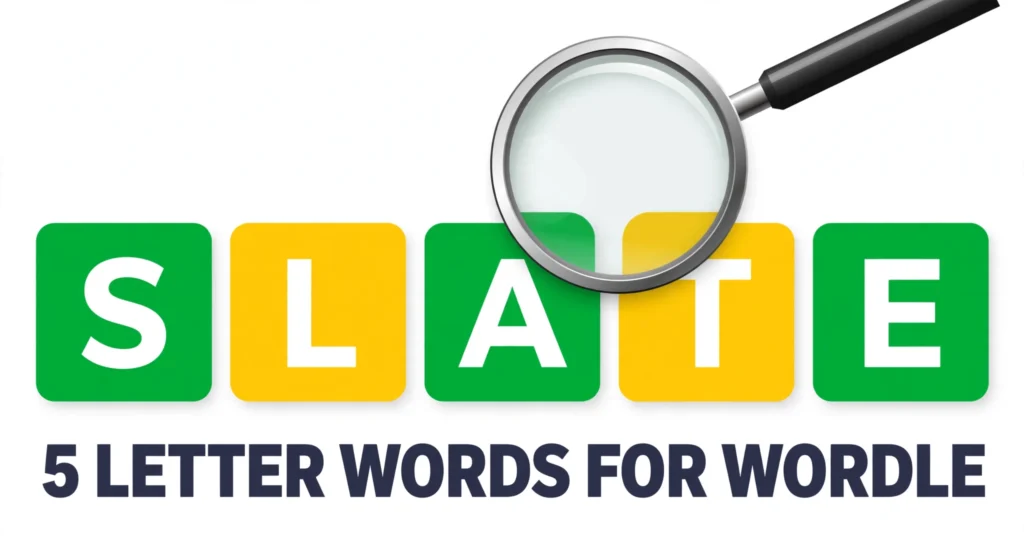
For example, SLATE tests S, L, A, T, and E. If the game marks A and E green, you immediately know their correct positions. If S appears yellow, you know it belongs somewhere else in the answer. Gray tiles help you eliminate letters that cannot be used, subject to Wordle’s duplicate-letter feedback rules.
Here are five balanced starting words to consider:
- SLATE: Tests three consonants and two vowels.
- CRANE: Combines common consonants with A and E.
- STARE: Tests S, T, R, A, and E.
- TRACE: Provides a different arrangement of common letters.
- CRATE: Tests C, R, A, T, and E.
There is no universally best starting word for every strategy. Different analyses can favor different words depending on the answer list, letter frequencies, and whether the objective is to maximize information or maximize the probability of solving the puzzle immediately.
For a deeper comparison, read our guide to the best Wordle starting words.
5-Letter Words Grouped by Common Patterns
Recognizing letter patterns is especially useful after your first few guesses. Once you know that an answer ends in ER or begins with ST, you can concentrate on words that fit the pattern rather than guessing randomly.
English contains many familiar combinations, including ST, CR, TR, and common endings such as ER and ED. These patterns do not guarantee that a word is the answer, but they provide a practical way to narrow your choices.
Words Ending in ER
Consider these five-letter words ending in ER:
UPPER, OTHER, EAGER, ENTER, COVER, NEVER, WATER, LOVER.
If your tiles suggest that the last two letters are E and R, examine the confirmed positions of the other letters before choosing a candidate. WATER and COVER may share the same ending, but their opening letters are different, so your previous feedback will help determine which candidates remain possible.
Words Ending in ED
These five-letter words end in ED:
BAKED, CARED, WIPED, HOPED, FIXED, MOVED, ASKED, CURED.
Remember that the final letters alone are not enough to establish the answer. Check whether each word matches your green and yellow tiles and whether it uses any letters already ruled out.
Words Beginning With ST, CR, and TR
If you have identified the first two letters, the following groups may help.
ST words: STONE, STEAM, STARE, STALE, STAND.
CR words: CRASH, CRISP, CRAFT, CRANE, CRIME.
TR words: TRUCK, TRAIL, TRACE, TRUST, TREAT.
These are useful examples of common five-letter patterns. Not every valid guess is necessarily an eligible daily answer, so use the game’s feedback to narrow the list rather than assuming that a familiar word must be the solution.
Vowel-Heavy 5-Letter Words for Wordle
Vowels are important because A, E, I, O, and U appear in many English words. Testing vowels early can help you identify which sounds may belong in the answer and which possibilities can be eliminated.
Useful vowel-focused guesses include:
ADIEU, AUDIO, OUIJA, IRATE, ORATE, ABOUT, IDEAL, OCEAN, ALIKE, EQUIP, OUGHT, RAISE.
ADIEU is popular because it tests A, E, I, and U in one guess. AUDIO tests A, U, I, and O. However, neither word is automatically the best opening choice for every player: both sacrifice some opportunities to test common consonants.
For example, if you start with AUDIO and discover that A and O are absent, you have eliminated two vowels but learned little about common consonants such as S, T, R, and L. A balanced word such as SLATE can provide a broader initial sample of letters.
A useful approach is to choose a vowel-heavy guess when you have a specific reason to test remaining vowels. If your first guess already identifies the vowels, move on to other letters instead of spending another attempt repeating information you already know.
Consonant-Heavy Words for Eliminating Letters
Sometimes your board already reveals one or two vowels, but several consonants remain uncertain. In this situation, a word containing useful new consonants can help you distinguish between possible answers.
Consider these five-letter words:
BLIMP, CRAMP, FLOCK, GRIND, CHIRP, PUNCH, DRAFT, CLIMB, FROST, PLUMB, GHOST, SPORT, ROUND.
Each word tests a different combination of letters. The best choice depends on which letters have already appeared in your guesses and which possibilities remain.
Suppose your first two attempts reveal A and E, while several common consonants remain untested. Rather than playing another word containing A and E in the same positions, you can select a guess that tests new consonants. This may help you separate several remaining candidates.
There is one important distinction: an elimination guess is intended to gather information, not necessarily to solve the puzzle immediately. It can be useful when you have enough attempts remaining, but it becomes riskier on your final guesses. Always consider the number of possible answers left before sacrificing an attempt to test letters.
How to Use 5-Letter Word Lists Strategically
A word list is most useful when you treat it as a decision-making aid rather than a collection of words to memorize. Your goal is to use each result to reduce uncertainty about the answer.
Start With a Balanced Word
Choose a word such as SLATE, CRANE, or STARE. These guesses test five different letters and provide a useful mix of consonants and vowels.
You can keep one preferred opener for consistency or rotate between a few options. Changing your starting word is a personal choice, not a requirement for solving Wordle.
Interpret the Tile Colors Correctly
Green: The letter is in the answer and in the correct position.
Yellow: The letter appears in the answer but is in a different position.
Gray: The letter is not available in the answer, although duplicate letters can make the feedback more nuanced.
Do not simply collect letters. Pay attention to their positions. If R turns yellow in the second position, your next candidate should place R somewhere else.
Use New Letters When They Add Information
Your second guess can test additional letters that did not appear in your opener. For instance, after SLATE, a word such as ROUND tests R, O, U, N, and D, providing a broad second sample.
However, avoid following a fixed second-word rule blindly. If your first guess reveals several green tiles, building on those confirmed letters may be more useful than ignoring them to test five new ones.
Switch to Pattern Matching
Once you have identified several letters, focus on words that fit the known positions. If your pattern is S _ A _ E, consider candidates that match all five positions and your remaining letter restrictions.
Do not choose a candidate merely because it looks familiar. Check every known green position and make sure yellow letters appear in different positions from their previous guesses.
Consider Repeated Letters
Wordle answers can contain repeated letters. Examples include LLAMA, EERIE, SASSY, and KNOLL. These examples are useful reminders that a word does not always contain five unique letters.
If you know several letters but cannot find a candidate that fits, consider whether one letter might appear twice. A repeated letter can explain why an apparently promising pattern does not match the words you initially considered.
Top 55 Useful 5-Letter Words for Wordle
The following collection contains 55 useful word examples, grouped by purpose. Some words appear in more than one category because they can serve different strategic roles. These are practical guesses and vocabulary examples, not a verified list of 55 distinct official Wordle answers.
Balanced Starting Words
SLATE, CRANE, TRACE, CRATE, STARE, RAISE, ARISE, AROSE, CARET, LEAST, LATER, ALTER, ALERT, REACT, ROAST.
Vowel-Focused Words
ADIEU, AUDIO, OUIJA, IRATE, ORATE, ABOUT, IDEAL, OCEAN, ALIKE, EQUIP, OUGHT, AISLE.
Consonant-Focused Words
BLIMP, CRAMP, FLOCK, GRIND, CHIRP, WRACK, PUNCH, DRAFT, CLIMB, FROST, PLUMB, GHOST, SPORT.
Familiar Five-Letter Words
LIGHT, NIGHT, STONE, HEART, WATER, PLANT, MONEY, WORLD, HOUSE, TRAIN, TABLE, POWER, GREEN, BLACK, BRAVE.
Use these lists as a starting point, not a substitute for the game’s feedback. A word may be valid in English without being included in the official daily answer list. Likewise, the fact that a word is a strong opener does not mean it is likely to be today’s answer.
How a Wordle Word Finder Can Help
When you have several confirmed letters but cannot identify the answer, a word finder can make the process easier. Instead of scanning a long list manually, you can filter candidate words according to known positions and excluded letters.
Our Wordle Word Finder can help you narrow the possibilities by entering known letters and excluding letters that your previous guesses have ruled out. Follow the tool’s instructions for specifying fixed positions and unknown letters.
For example, if your board shows S in the first position, A in the third position, and E in the fifth position, you can search for candidates matching S _ A _ E. Then remove any words containing letters you know are absent.
You can also visit the WordleHintHub homepage for additional Wordle hints and guidance. When you want to play the official daily game, use the New York Times Wordle page.
A word finder should support your reasoning rather than replace it. Always check the suggested candidates against your actual board, because a list may contain valid English words that are not accepted by the game or are not possible daily solutions.
Common Mistakes to Avoid When Choosing Wordle Words
One common mistake is repeatedly guessing words with the same letters without gaining new information. If a letter has already been ruled out, including it again usually wastes an opportunity to test another candidate.
Another mistake is focusing on vowels throughout the entire game. Vowels are useful early, but confirmed vowels should direct your attention toward the consonants and positions that remain uncertain.
Players also sometimes reject repeated-letter possibilities too quickly. Words such as LLAMA and SASSY demonstrate why it is important to consider duplicates when a pattern does not fit the expected candidates.
Finally, avoid assuming that the most popular starting word is always the best choice. Your strategy should change with the feedback. An opener that tests many useful letters is valuable, but once you have green and yellow tiles, the best next move is the one that uses that information effectively.
Frequently Asked Questions
What are the best 5-letter words to start Wordle?
SLATE, CRANE, STARE, TRACE, and CRATE are useful balanced starting words. They test a mixture of common consonants and vowels without repeating letters. The best option depends on the letter distribution and strategy you prefer.
Is ADIEU a good Wordle starting word?
ADIEU is useful for testing four vowels in a single guess. However, it tests only one consonant, so it may reveal less about common consonants than a balanced opener. It is a reasonable choice for players who prioritize early vowel information.
Can Wordle answers contain double letters?
Yes. Wordle answers can contain repeated letters, including words such as LLAMA, EERIE, SASSY, and KNOLL. If your confirmed letters do not fit any likely candidate, consider whether one letter might appear more than once.
How many five-letter words does Wordle accept?
The number depends on the game’s accepted-guess list and version. The list of words that can be guessed is larger than the set of possible daily answers. Therefore, a word being accepted as a guess does not necessarily mean it can appear as the solution.
What is a good second guess after SLATE?
ROUND is one option because it tests five new letters: R, O, U, N, and D. However, if SLATE reveals useful green or yellow tiles, a second guess that incorporates those clues may be more effective. Choose according to the information you already have.
Where can I find five-letter words by pattern?
You can use the Wordle Word Finder to narrow down words using known letters, fixed positions, and excluded letters. This can be particularly helpful when only a few possible answers remain.
Conclusion
Finding useful 5 letter words for Wordle is about more than memorizing a long list. Strong opening guesses, careful interpretation of tile colors, and recognition of common word patterns can help you make better decisions throughout the game.
Start with a balanced word, use vowel-focused or consonant-focused guesses when they provide useful new information, and switch to pattern matching as the board becomes clearer. Remember that repeated letters are possible and that no single starting word guarantees a win.
With a consistent approach and a reliable word finder, you can reduce random guessing, make better use of your six attempts, and approach each daily Wordle puzzle with greater confidence.
Put your word list to work: a strong vocabulary shines brightest with the right method — learn to decode every Wordle clue like a pro, master smarter solving techniques with our Wordle cheat guide, and when a puzzle truly beats you, today’s Wordle answer is one click away.
Pingback: Wordle Cheat: Smart Methods, Tools & When to Use Them - Wordle Hint Hub